Psilocybin vs psilocin: what's the difference?
Psilocybin is the stable form stored in the mushroom; psilocin is the active compound the body makes from it by removing a phosphate group. Because that phosphate has weight, psilocybin can turn into at most 0.719 times its mass in psilocin, which is the factor Oregon and Colorado use on lab reports.
On this page
- The short answer
- How does psilocybin become psilocin?
- Where does the 0.719 on lab reports come from?
- Why do psilocybin mushrooms bruise blue?
- Does stronger bluing mean stronger mushrooms?
- What are baeocystin, norbaeocystin, aeruginascin and norpsilocin?
- How does the body clear psilocin?
- Questions people ask
- Sources
The short answer
Psilocybin is a prodrug: once it's swallowed, the body quickly strips off its phosphate group and turns it into psilocin, the compound that acts on the brain's 5-HT2A serotonin receptors.1, 2 Because the phosphate adds weight, psilocybin can yield at most 0.719 times its own mass as psilocin, the ratio of the two molar masses listed in PubChem, and that is the factor in Oregon's and Colorado's "total psilocin" formulas.3, 4, 5
How does psilocybin become psilocin?
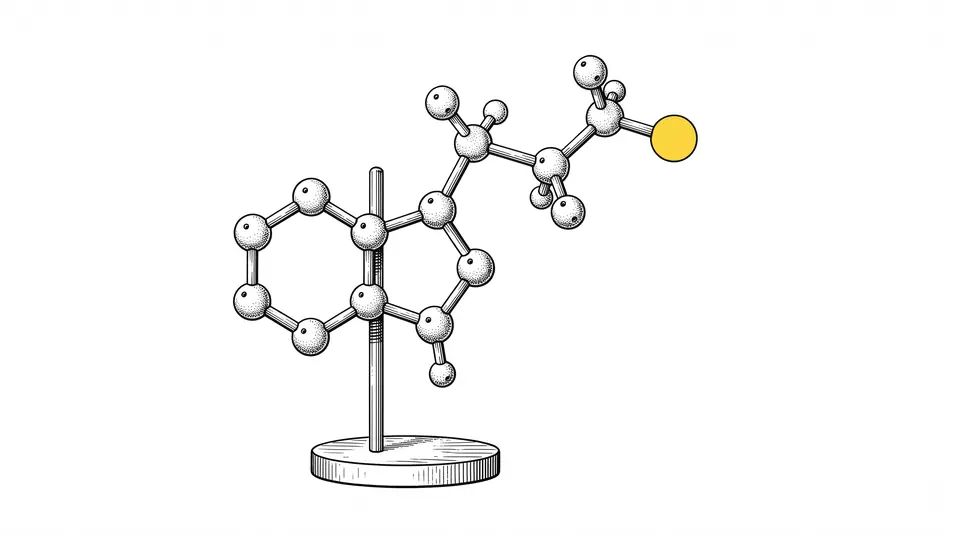
The two molecules are identical except at one spot. Psilocybin carries a phosphate group at the 4-position of its indole ring; psilocin has a plain hydroxyl (OH) group there instead.3 Removing that phosphate (dephosphorylation) turns one into the other.
In the body that step is fast. A 2025 systematic review of 19 publications, covering 12 clinical datasets, concluded that psilocybin "acts as a pro-drug and is rapidly absorbed and transformed to psilocin after oral administration".1 In a pharmacokinetic study of 12 healthy adults, researchers found no intact psilocybin at all in participants' plasma or urine.6 Psilocin then produces the psychedelic effects by acting at the 5-HT2A receptor.2
The mushroom runs the same reaction on itself when its tissue is damaged, the first step of the bruising described below.7
So when a lab report lists psilocybin and psilocin side by side, it isn't listing two different drugs. It's listing the same active compound in two forms: the part that hasn't been converted yet and the part that already has.
Where does the 0.719 on lab reports come from?
Psilocybin is the heavier molecule because of its phosphate group. PubChem gives molar masses of 284.25 for psilocybin and 204.27 for psilocin, both in grams per mole.3 Divide the second by the first and you get 0.7186, rounded to 0.719. If every psilocybin molecule in a sample lost its phosphate, the psilocin produced would weigh at most 71.9% as much as the psilocybin it came from. Running the conversion the other way gives about 1.39.
| Compound | Formula | Molar mass (g/mol) |
|---|---|---|
| Psilocybin | C12H17N2O4P | 284.25 |
| Psilocin | C12H16N2O | 204.27 |
| Baeocystin | C11H15N2O4P | 270.22 |
| Norbaeocystin | C10H13N2O4P | 256.19 |
| Aeruginascin (as listed, a cation) | C13H20N2O4P+ | 299.28 |
| Norpsilocin | C11H14N2O | 190.24 |
Regulators use the same factor. Oregon defines "total potential psilocin" as psilocin plus 0.719 times psilocybin, which its rules call "the maximum theoretical concentration of psilocin in the sample".4 Colorado's "Total Psilocin" uses the same arithmetic.5 Because some products are labeled in psilocin terms and others in psilocybin terms, the same powder can carry different milligram figures. Our guide to what the mg on a capsule label means works through one sample read several ways.
Why do psilocybin mushrooms bruise blue?
Psilocin's free hydroxyl group makes it easy to oxidize. Psilocybin's phosphate sits on that same spot and shields it.7
A 2020 study in Psilocybe cubensis worked out the sequence. When the mushroom is injured, a phosphatase enzyme called PsiP removes psilocybin's phosphate to give psilocin, and a laccase enzyme called PsiL then oxidizes the psilocin. The oxidized units join into chains, mostly of 3 to 13 psilocin units, and that mixture is the blue color. The authors wrote that their results imply psilocybin's phosphate "serves a reversible protective function".7
The same fragility shows up in the lab. In a 1982 study, mushroom extracts kept at room temperature "within six months lost all psilocin and some psilocybin".8 So a psilocin figure describes a sample on the day it was tested, not the mushroom as it was picked.
Does stronger bluing mean stronger mushrooms?
No, according to the studies that checked. Beug and Bigwood measured 20 Pacific Northwest species and wrote: "we could find no correlation between degree of bluing and either psilocybin or psilocin levels".8 A 2026 study of six species reported that visual bluing after freezing "does not necessarily correlate with psilocin levels".9
The chemistry explains why. Blue pigment is psilocin that has already been oxidized, so a deeply bruised mushroom shows where conversion and breakdown happened, not how much active compound is left. Meanwhile potency differs for reasons color doesn't show: in Beug and Bigwood's data, psilocybin and psilocin levels within a single species varied by "a factor of two to more than a factor of six" between collections.8 The published potency measurements collect those ranges.
What are baeocystin, norbaeocystin, aeruginascin and norpsilocin?
Some lab reports list psilocybin's close chemical relatives too.
- Baeocystin is psilocybin with one fewer methyl group on its nitrogen (4-phosphoryloxy-N-methyltryptamine). It was first described in 1968 from Psilocybe baeocystis, together with norbaeocystin.10
- Norbaeocystin (4-phosphoryloxytryptamine) has no methyl groups on that nitrogen.10, 3
- Aeruginascin has three, making it a trimethylammonium analogue of psilocybin. Its structure was reported in 2006 from the mushroom Inocybe aeruginascens.11
- Norpsilocin (4-hydroxy-N-methyltryptamine) stands to baeocystin as psilocin stands to psilocybin: it's the form without the phosphate. It was first reported as a natural product of P. cubensis in 2017, and the authors suggested it is the active compound released from baeocystin.12
The first three carry a phosphate, like psilocybin. In a 2024 study, baeocystin, norbaeocystin and aeruginascin were dephosphorylated by alkaline phosphatase in vitro at nearly the same rate as psilocybin, yet only psilocybin produced head twitches in rats, a behavior researchers use as a marker in psychedelic studies.13 The studies we found don't establish what these relatives do in people.
Whether they're counted depends on the lab and the rules. Colorado requires labs to test for psilocybin, psilocin, baeocystin, aeruginascin and norbaeocystin, but its "Total Psilocin" figure uses only psilocybin and psilocin.5 Each compound has an entry in our glossary.
How does the body clear psilocin?
Free psilocin doesn't linger. Three routes break it down:
- Glucuronidation. Enzymes called UGTs attach glucuronic acid to psilocin, making psilocin-O-glucuronide, which the kidneys can excrete. Of the 19 human UGT enzymes tested in a 2010 study, UGT1A10 had the highest activity and likely acts in the small intestine, while UGT1A9 is "likely the main contributor" once psilocin has been absorbed.14 In plasma, conjugated psilocin runs about four times higher than free psilocin.2
- Monoamine oxidase A (MAO-A). This enzyme turns psilocin into 4-HIA, which other enzymes convert to 4-HIAA. MAO-A made only minimal amounts in lab tests,2 but a 2025 review of the clinical data concluded that psilocin "is mainly transformed to 4-hydroxyindole-3-acetic acid [4-HIAA] and in less amounts to conjugated psilocin", with a significant portion likely converted before it reaches the bloodstream.1
- Liver CYP enzymes. Of eight CYP enzymes tested in vitro, only CYP2D6 and CYP3A4 showed relevant activity against psilocin, and CYP2D6 genotype didn't change psilocin blood levels in the people studied.2
Across published studies, the average elimination half-life of free psilocin ranged from 1.23 to 4.72 hours, and only 1.5% to 3.4% of a dose left the body in urine as psilocin itself.1
Thomann and colleagues expected glucuronidation to stay the predominant route and called MAO inhibition "potentially less important" for psilocin levels;2 the 2025 review points more toward 4-HIAA, so this isn't settled.1 Neither finding makes MAO inhibitors safe to combine: our interaction reference covers the MAOI, lithium and antidepressant evidence.
Questions people ask
Is psilocin stronger than psilocybin?
Psilocin is the form that acts on receptors, and psilocybin works by becoming psilocin.1 By weight, psilocybin carries the extra mass of its phosphate group, so a given weight of psilocybin can produce at most 71.9% as much psilocin.3 That's a fact about molecular weight, not a prediction of how anyone will respond.
Which one shows up in blood and urine?
Are psilocybin and psilocin both illegal?
Under federal law, yes. Both psilocybin and psilocyn (an older spelling of psilocin) are listed as Schedule I hallucinogenic substances.15 Oregon and Colorado run state-regulated programs in licensed settings, but federal law still applies there.
Sources
- Otto ME, et al. Clinical pharmacokinetics of psilocin after psilocybin administration: a systematic review and post-hoc analysis. Clin Pharmacokinet, 2025;64(1):53-66. PMID 39812743.
- Thomann J, et al. In vitro and in vivo metabolism of psilocybin's active metabolite psilocin. Front Pharmacol, 2024;15:1391689. PMID 38741590.
- PubChem compound records: psilocybin (CID 10624), psilocin (CID 4980), baeocystin, norbaeocystin, aeruginascin and norpsilocin. National Library of Medicine, retrieved October 26, 2026.
- Oregon Administrative Rules chapter 333, division 64 (accreditation of laboratories, including psilocybin testing): OAR 333-064-0025, -0140, -0150. Oregon Secretary of State, retrieved October 26, 2026.
- 1 CCR 213-1, Natural Medicine Rules (Rules 1025, 3305, 4010, 4015, 7015, 8030), current version, including emergency rules effective August 12, 2026. Colorado Department of Revenue, Natural Medicine Division, retrieved October 26, 2026.
- Brown RT, et al. Pharmacokinetics of escalating doses of oral psilocybin in healthy adults. Clin Pharmacokinet, 2017;56(12):1543-1554. PMID 28353056.
- Lenz C, et al. Injury-triggered blueing reactions of Psilocybe "magic" mushrooms. Angew Chem Int Ed, 2020;59(4):1450-1454. PMID 31725937.
- Beug MW, Bigwood J. Psilocybin and psilocin levels in twenty species from seven genera of wild mushrooms in the Pacific Northwest, U.S.A. J Ethnopharmacol, 1982;5(3):271-285. PMID 7201053.
- Windsor C, et al. Development of Psilocybe mushroom species reference material. J AOAC Int, 2026;109(1):37-50. PMID 39960890.
- Leung AY, Paul AG. Baeocystin and norbaeocystin: new analogs of psilocybin from Psilocybe baeocystis. J Pharm Sci, 1968;57(10):1667-1671. PMID 5684732.
- Jensen N, Gartz J, Laatsch H. Aeruginascin, a trimethylammonium analogue of psilocybin from the hallucinogenic mushroom Inocybe aeruginascens. Planta Med, 2006;72(7):665-666. PMID 16673333.
- Lenz C, Wick J, Hoffmeister D. Identification of omega-N-methyl-4-hydroxytryptamine (norpsilocin) as a Psilocybe natural product. J Nat Prod, 2017;80(10):2835-2838. PMID 28929753.
- Rakoczy RJ, et al. Pharmacological and behavioural effects of tryptamines present in psilocybin-containing mushrooms. Br J Pharmacol, 2024;181(19):3627-3641. PMID 38825326.
- Manevski N, et al. Glucuronidation of psilocin and 4-hydroxyindole by the human UDP-glucuronosyltransferases. Drug Metab Dispos, 2010;38(3):386-395. PMID 20007669.
- 21 CFR 1308.11, Schedule I, paragraph (d) hallucinogenic substances: (29) psilocybin, (30) psilocyn. Electronic Code of Federal Regulations, current as of October 23, 2026.
Keep reading
 Psilocybin potency: every magic mushroom lab measurement we could findPsilocybin measured in mushrooms, from 42 published sources, shown as ranges, with a free dataset to download.
 What does the mg on a mushroom capsule label mean?Powder weight, psilocybin or total psilocin? How to read a label and the batch lab report behind it.
 Psilocybin drug interactions: lithium, SSRIs, MAOIs and 23 more26 medicine and drug classes: what research found when each met psilocybin, and how strong the evidence is.
Written and checked by the Dosage Calculator editors. Every figure on this page links to its source. Found an error? Tell us and we'll correct it in the open, as our editorial standards describe. Magic Mushroom Dosage Calculator is published by the team that runs My Mushroom Dispensary, an online shop. We sell no advertising and nothing on this site.